
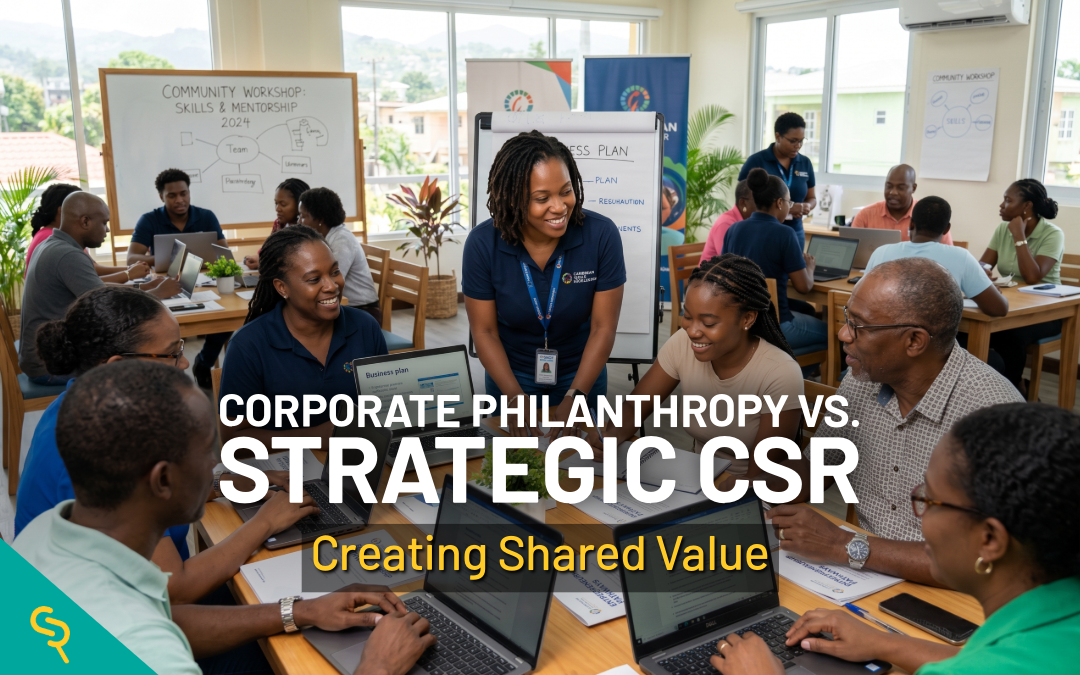
Corporate Philanthropy vs. Strategic CSR: Creating Shared Value
By Esther Le Gendre, Managing Director of Bridge Consultants and Certified CSR Auditor
In the ever-evolving business of communications and stakeholder management, debates about the role of companies in society continue to grow. In 1988, the International Public Relations Association (IPRA) Gold Paper No. 6 compared Public Relations and Propaganda, exploring their societal value. Today, the focus has shifted to Corporate Social Responsibility (CSR) versus Corporate Philanthropy—is it strategy or simply a “nice-to-do” activity?
The core question is: what should companies do, and why, to fulfill their social responsibility? In this context, traditional philanthropy, often seen as warm and fuzzy, faces scrutiny for its intangible outcomes compared to strategically implemented CSR.
Related Link: IPRA Gold Papers
The Origins of Philanthropy (Prometheus Bound)
Understanding a word’s history can reveal its essence. The 5th-century playwright Aeschylus, in Prometheus Bound, combined words meaning “loving” and “humanity” to express the “love of humanity”—the essence of early philanthropy.
Today, corporate philanthropy represents companies’ efforts to give back to society, whether through financial donations, in-kind support, or community projects. High-impact philanthropy now uses metrics to assess employee engagement, social impact, and brand value, ultimately linking goodwill to tangible business outcomes.
The Problem with Traditional Philanthropy
Philanthropy, while socially beneficial, consumes financial resources. Investors increasingly seek justification for expenses that align with business strategy and satisfy stakeholders.
Companies operate within a symbiotic relationship with society: communities provide resources—financial, material, and human—while companies provide employment, goods, and services. This mutual dependency suggests businesses should pursue initiatives that are mutually beneficial to both society and their operations.
Defining Corporate Social Responsibility (CSR)
CSR is the response of business to society’s expectations, taking responsibility for its social, environmental, and financial impacts. Contemporary CSR definitions focus on:
- Economic and social impact
- Adherence to legal and ethical requirements
- Voluntary and philanthropic nature of activities
- Sustainability of environmental programs
- Measurable outcomes of interventions
Companies, particularly in industrial sectors near fence-line communities, use CSR to maintain a social license to operate, mitigating protests and operational risks.
CSR extends beyond philanthropy to include:
- Environmental protection
- Employee development and safe workplaces
- Ethical supply chain management (no child labor, no animal harm)
- Community education and skills training
The Porter and Kramer Framework (2006)
Porter and Kramer, in their Harvard Business Review article (2006), critiqued fragmented CSR approaches. They proposed a framework to:
- Identify the full societal impact of a company
- Prioritize social issues affecting the business and stakeholders
- Align CSR with corporate strategy for mutual benefit
“A corporate social agenda looks beyond community expectations to opportunities to achieve social and economic benefits simultaneously.” – Porter & Kramer, 2006
This approach ensures that CSR advances business strategy while improving social conditions, moving from mitigating harm to creating shared value.
Related Link: Strategy & Society: The Link Between Competitive Advantage and Corporate Social Responsibility
Case Study: Transforming Fence-Line Communities into Skilled Labor
One local company, with international partners, faced challenges in its fence-line community: high unemployment and drug abuse threatened safe operations and competitiveness.
The company implemented a strategic CSR program:
- Drug testing and above-average wages ensured safe operations.
- Partnered with skills education institutions to provide funded training programs.
- Trained residents were prioritized for employment, and excess skilled workers were absorbed by other employers.
- On-the-job training and technology transfer enhanced local capabilities.
Results:
- Decrease in drug abuse
- Increase in skilled labor availability
- Reduction in local unemployment
This case demonstrates that integrating CSR with human resources and business strategy creates measurable shared value.
Conclusion: Achieving Shared Value
CSR is not just philanthropy. It is a strategic business activity that consumes resources but has the power to transform communities while sustaining company performance. Successful CSR aligns social agendas with corporate objectives, creating long-term benefits for both business and society.
About the Author:
@Esther Le Gendre is the Managing Director of Bridge Consultants and a certified CSR auditor. Her expertise lies in strategic CSR, shared value creation, and corporate community engagement.
📧 Email: farside119@hotmail.com