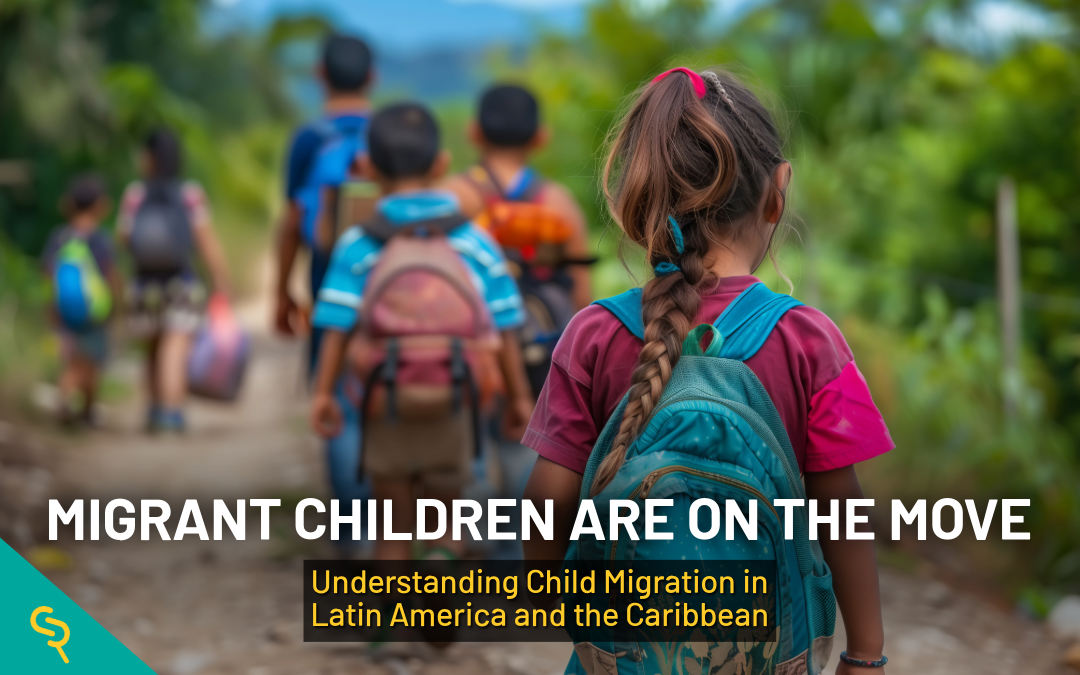
Migrant Children Are on the Move: Understanding Child Migration in Latin America and the Caribbean
The Growing Humanitarian Crisis Facing Migrant Children
Child migration in Latin America and the Caribbean has reached unprecedented levels, creating one of the region’s most urgent humanitarian challenges. Across migration routes stretching from South America through Central America and toward North America, thousands of children and families are undertaking dangerous journeys driven by violence, poverty, political instability, food insecurity, and climate-related displacement (United Nations Children’s Fund [UNICEF], 2023).
According to UNICEF, more than 60,000 children crossed the Darién Gap during the first seven months of 2023 alone — the highest number ever recorded at the time (UNICEF, 2023). The migration route, considered one of the most dangerous in the world, has become a major corridor for migrants travelling from South America toward the United States and Canada.
The increasing movement of children across Latin America and the Caribbean has intensified calls for stronger humanitarian responses, improved migration protections, and expanded regional cooperation through initiatives such as the Regional Refugee and Migrant Response Plan (RMRP) coordinated by the International Organization for Migration and regional partners (IOM, 2023).
Why Are Children Migrating Across Latin America and the Caribbean?
The drivers of child migration are complex and interconnected. According to UNICEF and regional humanitarian agencies, children and families are increasingly displaced due to:
- Gang violence and organised crime
- Political instability
- Extreme poverty and unemployment
- Climate change and environmental disasters
- Food insecurity
- Limited access to healthcare and education
- Family reunification efforts
- Economic collapse in neighbouring countries
These pressures have significantly increased migration flows throughout the region, particularly among vulnerable populations such as unaccompanied minors and low-income families (UNICEF, 2023).
Garry Conille noted that younger children are now making these dangerous journeys at increasing rates, with children under the age of 11 accounting for up to 91% of children moving through key transit points in the region (UNICEF, 2023).
Globally, children account for approximately 13% of the migrant population. However, in Latin America and the Caribbean, children represent roughly 25% of all migrants on the move — the highest regional proportion in the world (UNICEF, 2023).
The Darién Gap Migration Route: One of the World’s Most Dangerous Journeys
The Darién Gap is widely regarded as one of the most perilous migration routes on earth. The 66-mile (106-kilometre) stretch of dense mountainous rainforest connects Colombia and Panama and serves as a critical transit corridor for migrants travelling northward.
Migrants crossing the Darién Gap face extreme risks including:
- Disease and dehydration
- Injury and exhaustion
- Family separation
- Human trafficking and abuse
- Exposure to armed criminal groups
- Lack of food, water, and medical care
- Dangerous terrain and severe weather conditions
UNICEF has warned that even when migrant children survive the journey, many continue to face uncertainty, exploitation, and limited protection at their destinations (UNICEF, 2023).
The scale of migration through the Darién Gap has increased dramatically over the past decade. Nearly 250,000 people crossed the route in 2022 — almost double the figure recorded in 2021 and approximately 20 times the annual average observed between 2010 and 2020 (Rios & Chen, 2023).
The migration surge has also placed increasing pressure on immigration systems throughout the Americas, particularly along the southern border of the United States.
Humanitarian Pressures at the US Southern Border
The growing movement of migrants through Latin America has created significant political and humanitarian pressures for governments throughout the hemisphere.
In the United States, rising migration numbers have intensified debate surrounding border security, refugee protection, and immigration policy. Reports from US border officials indicated that the number of migrant families encountered at the border nearly doubled between June and July 2023, raising concerns about humanitarian capacity and child protection systems (Rios & Chen, 2023).
The increasing number of unaccompanied minors and vulnerable families has highlighted the need for expanded regional cooperation and stronger protection frameworks for migrant children. Organisations such as UNICEF, IOM, and the Regional Inter-Agency Coordination Platform for Refugees and Migrants from Venezuela (R4V) continue to advocate for safer and more regular migration pathways for children and families throughout the region (R4V, 2023).
Venezuelan Migrants in Guyana: A Regional Humanitarian Challenge
Closer to the Caribbean, Guyana has experienced a growing influx of Venezuelan migrants due to its proximity to the Venezuela-Guyana border.
According to estimates from the International Organization for Migration, more than 33,000 Venezuelan migrants are currently living in Guyana, many of whom entered through Region One by boat as economic refugees (IOM, 2023).
Migrants are often drawn to Guyana in search of employment, healthcare, educational opportunities, and improved living conditions for their children. Guyana’s strong education system and reputation for academic performance within the Caribbean have made the country particularly attractive to migrant families (Gouveia, 2024).
However, the growing migrant population has placed significant pressure on national resources, including healthcare, housing, water access, education, and social services.
Robert Natiello acknowledged that the migration crisis has increased demand on Guyana’s public services while also recognising the country’s efforts to support migrant integration and humanitarian assistance (Gouveia, 2024).
The situation has become increasingly complex amid rising political tensions between Guyana and Venezuela over territorial disputes.
The Need for a Stronger Humanitarian Response in the Caribbean
Humanitarian agencies continue to stress that migration across Latin America and the Caribbean is not solely a border issue but a broader human development challenge requiring coordinated regional action.
The growing number of migrant children highlights the urgent need for:
- Child protection services
- Access to education and healthcare
- Safe migration pathways
- Regional humanitarian coordination
- Anti-trafficking protections
- Mental health and psychosocial support
- Long-term social integration programmes
According to UNICEF (2023), governments and regional stakeholders must strengthen protection systems for migrant children while addressing the root causes of displacement, including poverty, violence, and climate vulnerability.
The Caribbean’s response to migration will increasingly require collaboration among governments, NGOs, private sector organisations, and international agencies to ensure that vulnerable children and families are protected throughout the migration process.
Child Migration and the Future of Regional Stability
The rise in child migration across Latin America and the Caribbean reflects deeper structural challenges affecting the region, including inequality, climate insecurity, economic instability, and political conflict.
As migration patterns continue evolving, the humanitarian response must move beyond emergency intervention toward sustainable regional policies that prioritise child protection, social inclusion, and long-term development.
The movement of migrant children through dangerous migration corridors such as the Darién Gap is not only a humanitarian issue but also a significant regional development concern that will shape social policy, public services, and international cooperation for years to come.
References
Gouveia, S. (2024). Migrant children are on the move. Corporate Sustainability Review 2023–2024, 52–53.
International Organization for Migration. (2023). Guyana migration profile and regional migration trends. IOM Caribbean Office. https://www.iom.int
R4V. (2023). Regional Refugee and Migrant Response Plan 2023–2024. Regional Inter-Agency Coordination Platform for Refugees and Migrants from Venezuela. https://www.r4v.info
Rios, M., & Chen, H. (2023). UN warns of record number of child migrants in Latin America and Caribbean. CNN
United Nations Children’s Fund. (2023). Child migration in Latin America and the Caribbean. UNICEF Latin America and Caribbean Regional Office. https://www.unicef.org/lac