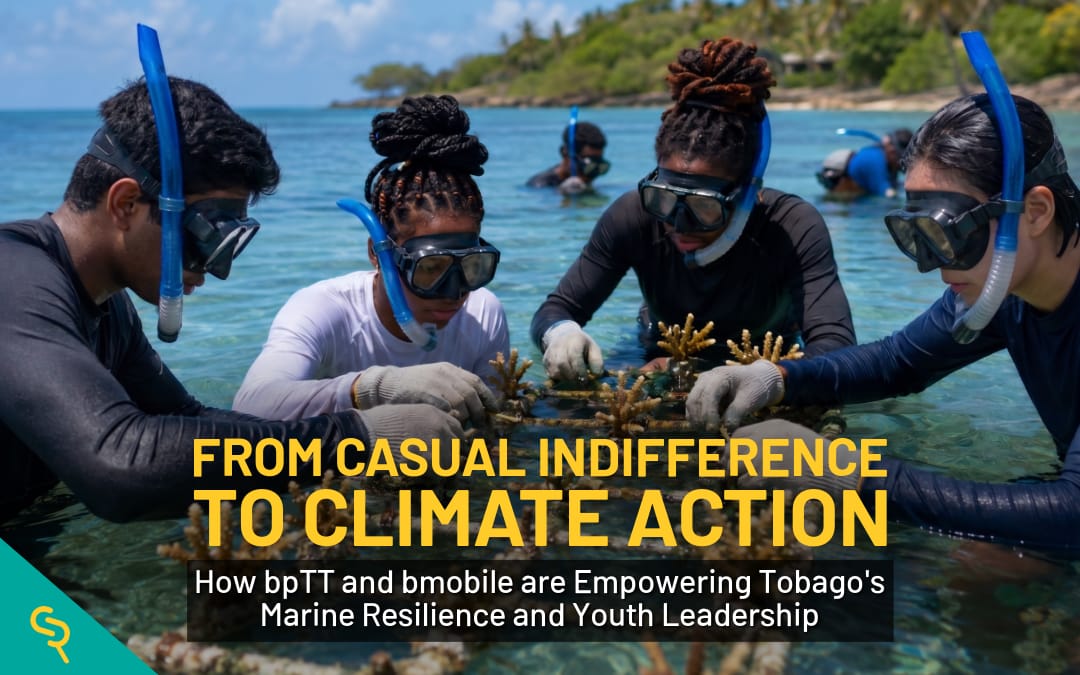

From Casual Indifference to Climate Action: How bpTT and bmobile are Empowering Tobago’s Marine Resilience and Youth Leadership
Climate change is no longer a distant concept for Trinidad and Tobago. It is visible in rising flood events, declining fish stocks, coral reef destruction, and increasing economic pressure on coastal communities. At the same time, a new generation of environmental advocates, scientists, entrepreneurs, and athletes is redefining how sustainability and social investment can drive long-term national resilience.
Two major corporate social responsibility (CSR) initiatives — bpTT’s partnership with the Institute of Marine Affairs (IMA) through the MARIN Tobago project and bmobile’s investment in youth entrepreneurship and sports development — demonstrate how strategic corporate partnerships can create measurable environmental and social impact.
Together, these programmes are shaping the future of marine resilience and coral restoration in Tobago while also strengthening youth entrepreneurship and sports sponsorship in Trinidad and Tobago.
Why Is Tobago Experiencing More Flooding Despite Less Rainfall?
Climate scientists point to several interconnected factors: rising sea levels, degraded wetlands, reduced mangrove coverage, and poor coastal ecosystem health. Healthy mangroves and seagrass beds naturally absorb excess water and reduce coastal erosion, but ecosystem destruction weakens these natural defenses (Intergovernmental Panel on Climate Change [IPCC], 2023).
Why Is Fish Becoming More Expensive in Trinidad and Tobago?
Overfishing, coral reef degradation, pollution, and the destruction of marine breeding grounds are reducing fish populations. Species that depend on healthy coral reefs and mangrove nurseries struggle to reproduce when these ecosystems are damaged (Food and Agriculture Organization [FAO], 2022).
What Is Causing the Decline of Buccoo Reef?
Buccoo Reef faces multiple environmental pressures, including warming ocean temperatures, coral bleaching, invasive sargassum blooms, pollution, and unsustainable coastal development. Scientists also warn that the Caribbean-wide spread of Stony Coral Tissue Loss Disease poses an additional long-term threat to Tobago’s reef systems (AGRRA, 2023).
Marine Resilience and Coral Restoration Tobago: Inside the MARIN Tobago Project
The Marine Resilience Initiative (MARIN Tobago) is a partnership between bpTT and the Institute of Marine Affairs (IMA) focused on restoring Tobago’s coastal ecosystems and strengthening climate resilience.
The project targets three interconnected marine habitats:
- Coral reefs
- Seagrass beds
- Mangrove ecosystems
These ecosystems work together to protect coastlines, support biodiversity, and sustain tourism and fishing industries.
According to bpTT’s Vice President of Corporate Operations, Giselle Thompson, the MARIN Tobago project was the first biodiversity initiative selected among bp’s global environmental projects. The programme combines scientific restoration with community engagement and environmental education.
The initiative aims not only to restore ecosystems but also to develop long-term marine stewardship among NGOs, fishermen, tour operators, schools, and coastal communities.
What Is Blue Carbon and Why Does Tobago Need It?
One of the most important concepts driving the MARIN Tobago project is “blue carbon.”
Blue carbon refers to the carbon captured and stored by marine ecosystems such as mangroves, seagrass beds, and salt marshes. These ecosystems absorb carbon dioxide from the atmosphere and store it in biomass and sediments for long periods, helping to mitigate climate change (United Nations Environment Programme [UNEP], 2020).
Seagrasses are especially valuable because they capture carbon while simultaneously:
- Protecting coastlines from erosion
- Supporting marine biodiversity
- Improving water quality
- Serving as fish nursery habitats
Attish Kanhai, co-lead on the MARIN project and a Benthic Ecologist, highlighted the importance of Tobago’s Turtle Grass ecosystems, which possess dense root systems capable of significant carbon storage.
How Does Seagrass Help With Carbon Capture in the Caribbean?
Seagrasses remove carbon dioxide through photosynthesis and trap carbon-rich sediments beneath the ocean floor. Because these underwater ecosystems can store carbon for centuries, they are considered one of the Caribbean’s most effective nature-based solutions to climate change.
The Bon Accord Lagoon and Buccoo Reef areas contain Tobago’s most extensive seagrass beds, making their restoration critically important for climate resilience and biodiversity protection.
Nature-Based Solutions Are Becoming Central to Climate Policy
The MARIN Tobago project reflects a growing international shift toward nature-based solutions climate change strategies.
Rather than relying solely on engineered infrastructure, nature-based solutions use ecosystem restoration to address environmental and social challenges simultaneously. According to the International Union for Conservation of Nature (IUCN, 2022), restoring coastal ecosystems can improve food security, reduce climate vulnerability, and support sustainable tourism economies.
For small island developing states like Trinidad and Tobago, these strategies are increasingly essential.
Why Is Parrotfish Protection Important for Coral Reefs?
Parrotfish play a critical role in coral reef conservation because they consume algae that compete with coral for space and sunlight.
Without parrotfish, algae can rapidly overgrow reefs, preventing young corals from developing properly. This contributes to reef collapse and biodiversity decline.
Scientists involved in MARIN Tobago continue to educate communities and fishermen about sustainable fishing practices and the ecological importance of parrotfish coral reef conservation.
Stony Coral Tissue-Loss Disease Caribbean Threats Continue to Grow
Although Tobago has not yet experienced major outbreaks of Stony Coral Tissue Loss Disease (SCTLD), marine scientists remain cautious.
The disease has devastated coral populations throughout parts of Florida and the wider Caribbean, causing widespread mortality among hard coral species. Researchers warn that stronger marine management practices, sustainable tourism protocols, and stricter vessel sanitation measures are necessary to delay or prevent outbreaks in Tobago.
Gen Z Environmental Activism Is Reshaping Sustainability Conversations
Environmental awareness among younger generations is accelerating global sustainability movements.
The MARIN Tobago project intentionally targets youth climate action through:
- University talks
- Volunteer restoration programmes
- Social media campaigns
- NGO partnerships
- Community field exercises
Dr. Rahana Juman of the IMA emphasized that public engagement is essential for long-term environmental success. The project encourages citizens to view themselves not as separate from nature, but as participants within interconnected ecosystems.
This messaging strongly resonates with Gen Z environmental activism, which increasingly prioritizes climate accountability, ethical consumption, and biodiversity protection.
Youth Entrepreneurship and Sports Sponsorship Trinidad: How bmobile Is Investing in Future Leaders
While bpTT focuses on environmental sustainability, bmobile’s CSR strategy centers on youth empowerment through entrepreneurship, sports, education, and mentorship.
The company’s initiatives recognize that sustainable national development depends on investing in human capital and creating opportunities for young people to thrive.
Two standout programmes include:
- The YBTT JumpSTART programme
- The long-standing Keshorn Walcott bmobile partnership
Keshorn Walcott and bmobile: A Partnership Built on Long-Term Support
Olympic gold medalist Keshorn Walcott described bmobile as one of the foundational supporters throughout his athletic journey.
Since winning Olympic gold in 2012, Walcott’s relationship with bmobile has extended beyond sponsorship into youth mentorship and community outreach initiatives.
Following a serious Achilles tendon injury before the 2023 World Athletics Championships, Walcott credited long-term corporate support systems as critical to athlete resilience and recovery.
His story highlights the importance of sustained youth sports sponsorship in Trinidad and Tobago, especially for athletes competing on the international stage.
Best Entrepreneurship Training for Youth in Trinidad and Tobago
The YBTT JumpSTART programme has emerged as one of the country’s most impactful youth entrepreneurship initiatives.
Designed to help young entrepreneurs launch and scale businesses, the programme combines training, mentorship, networking, and business development support.
Participants receive guidance in areas such as:
- Digital marketing
- Business-to-business (B2B) scaling
- Customer acquisition
- Financial planning
- Sales strategy
- Pitch development
- Brand positioning
- Entrepreneurial mindset building
Since 2019, YBTT JumpSTART has graduated more than 140 young entrepreneurs.
YBTT JumpSTART Programme Success Stories
Entrepreneurs participating in the programme highlighted the value of mentorship and practical business guidance.
Khachielle Farmer developed “Chielle’s Design Experience” through mentorship sessions and collaborative workshops. She credited the programme with helping transform an idea into a viable business model.
Ayodhya Ouditt, winner of the Most Innovative and Social Business Idea category, emphasized the importance of mentorship in refining premium B2B CSR services and scaling client acquisition strategies.
Atiba Henry used the programme to strengthen his Caribbean confectionery business, Kree’s Yumplicity, while expanding professional networks and operational strategy.
Why Mentorship Matters in Youth Entrepreneurship
Mentorship remains one of the strongest predictors of entrepreneurial success.
YBTT General Manager Shedron Collins described the programme as an opportunity for participants to build their own “advisory board” of experienced professionals.
For many young entrepreneurs, access to strategic guidance, accountability, and industry expertise can significantly improve business survival rates and long-term scalability (OECD, 2021).
Corporate Partnerships Are Critical to Sustainable Development
Both MARIN Tobago and the YBTT JumpSTART programme demonstrate how public-private partnerships can strengthen resilience across environmental, economic, and social sectors.
bpTT’s investment in marine restoration and bmobile’s support for youth leadership reveal a broader shift in CSR strategy — one focused not simply on philanthropy, but on long-term systems change.
From coral restoration and blue carbon research to entrepreneurship mentorship and athletic development, these initiatives show that sustainability requires both environmental stewardship and human empowerment.
The future of Trinidad and Tobago’s resilience may ultimately depend on how effectively these two priorities continue to work together.
References
AGRRA. (2023). Stony Coral Tissue Loss Disease in the Caribbean. Atlantic and Gulf Rapid Reef Assessment. https://www.agrra.org/coral-disease-outbreak/
Food and Agriculture Organization. (2022). The State of World Fisheries and Aquaculture 2022. FAO. https://www.fao.org/publications/sofia/2022/en/
Intergovernmental Panel on Climate Change. (2023). Climate Change 2023: Synthesis Report. IPCC. https://www.ipcc.ch/report/ar6/syr/
International Union for Conservation of Nature. (2022). Nature-based Solutions for Climate Resilience. IUCN. https://www.iucn.org/resources/issues-brief/nature-based-solutions
Organisation for Economic Co-operation and Development. (2021). The Missing Entrepreneurs 2021: Policies for Inclusive Entrepreneurship and Self-Employment. OECD Publishing. https://doi.org/10.1787/71b7a9bb-en
United Nations Environment Programme. (2020). Out of the Blue: The Value of Seagrasses to the Environment and to People. UNEP. https://www.unep.org/resources/report/out-blue-value-seagrasses-environment-and-people