
Autism Awareness and Inclusion in Trinidad and Tobago: How Commonwealth Awardee Maya Nanan Is Transforming Support for Neurodivergent Youth
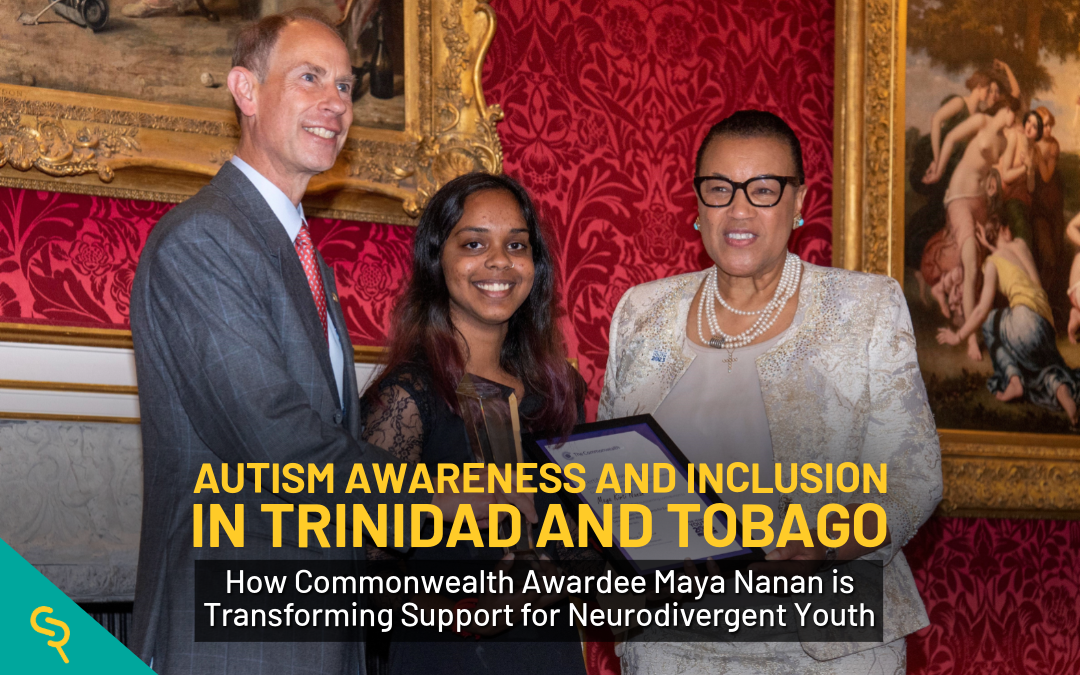
Autism awareness and inclusion in Trinidad and Tobago has gained growing visibility through the advocacy work of young activist Maya Nanan. As the first and only Trinidad and Tobago recipient of the Queen’s Commonwealth Trust Youth Venture Programme grant in 2022, Maya has become one of the Caribbean’s leading youth voices on neurodiversity, disability inclusion, and autism advocacy.
Through the establishment of Rahul’s Clubhouse and the Autism Siblings and Friends Network, Maya is helping to reshape how autistic individuals are supported, included, and empowered within Caribbean society.
Her work aligns strongly with the United Nations Sustainable Development Goals (SDGs), particularly SDG 3 (Good Health and Wellbeing), SDG 4 (Quality Education), SDG 10 (Reduced Inequalities), and SDG 16 (Peace, Justice and Strong Institutions) (United Nations, 2023).
Who Is Maya Nanan?
At just 18 years old, Maya Nanan received international recognition for her pioneering work supporting autistic individuals and advocating for autism awareness and inclusion in Trinidad and Tobago.
The Queen’s Commonwealth Trust Youth Venture Programme awarded Maya a grant commemorating Queen Elizabeth II’s Platinum Jubilee, recognising her leadership in creating safe and inclusive spaces for neurodivergent individuals.
Her activism was deeply inspired by her brother Rahul, who is on the autism spectrum. Witnessing the barriers he faced in education, socialisation, and public acceptance motivated Maya to advocate for meaningful inclusion and equal opportunity.
What Is Rahul’s Clubhouse?
Rahul’s Clubhouse is an autism-friendly centre created to provide educational, therapeutic, and social support for autistic individuals across Trinidad and Tobago.
The centre was designed as a safe, sensory-conscious environment where persons on the autism spectrum can access developmental programmes while interacting comfortably with peers, volunteers, and caregivers.
The facility supports individuals ranging from two to 35 years old and provides:
- Educational programmes
- Socialisation opportunities
- Therapeutic support
- Family engagement activities
- Volunteer-led interventions
- Caregiver training
- Access to professional guidance
Special attention is given to reducing sensory overload through careful management of lighting, sound, and environmental stimuli — an important consideration for many autistic individuals.
The centre also incorporates safeguarding policies and operational standards developed with support from representatives of the Queen’s Commonwealth Trust to ensure compliance with international best practices.
Understanding Autism Spectrum Disorder (ASD)
Autism Spectrum Disorder (ASD) is a neurodevelopmental condition that affects communication, behaviour, sensory processing, and social interaction. According to Maya Nanan, autism presents differently in every individual, meaning that no two autistic persons experience the condition in the same way.
Common Early Signs of Autism
Some common indicators of autism may include:
- Limited eye contact
- Delayed speech development
- Repetitive behaviours
- Sensory sensitivities
- Walking on tiptoes
- Arm flapping or spinning
- Difficulty with social interaction
- Non-verbal communication challenges
Research consistently shows that early intervention significantly improves developmental outcomes and independence for autistic individuals (World Health Organization [WHO], 2023).
Levels of Autism Spectrum Disorder
| ASD Level | Support Requirement | Description |
|---|---|---|
| Level 1 | Requires support | Individuals may function independently but need assistance with communication and social interaction |
| Level 2 | Requires substantial support | Greater difficulty with verbal and social communication and behavioural flexibility |
| Level 3 | Requires very substantial support | Significant communication challenges and high support needs |
This structured understanding helps caregivers, educators, and healthcare providers develop more effective support systems for autistic individuals.
Challenges Facing Autism Support in Trinidad and Tobago
Limited Access to Therapy
One of the most pressing issues affecting autism inclusion in Trinidad and Tobago is the shortage of qualified therapists and developmental specialists.
According to Maya, therapy services are expensive and geographically concentrated in urban areas such as San Fernando and Port of Spain, making accessibility difficult for families in rural communities.
A single 45-minute therapy session can cost approximately TT$300, placing consistent intervention beyond the reach of many households.
Gaps in Public Education Inclusion
Maya also highlights the absence of sufficient programmes to integrate autistic students into the mainstream public education system.
Inclusive education remains a major challenge throughout many Caribbean nations, where limited institutional resources, inadequate teacher training, and insufficient specialised support continue to impact neurodivergent students (UNESCO, 2020).
The Need for Rural and Accessible Autism Services
The concentration of services in urban centres highlights the growing need for:
- Mobile autism services
- Tele-therapy for autism in the Caribbean
- Community-based support programmes
- Expanded caregiver training
- Increased public-sector investment
Digital health and teletherapy models are increasingly recognised as effective tools for expanding autism support in underserved communities (UNICEF, 2022).
Autism Siblings and Friends Network: Building a Volunteer Movement
Maya began the Autism Siblings and Friends Network at the age of 12 alongside friends and relatives who wanted to support autistic individuals and their families.
What began as a small grassroots initiative has since grown into a registered non-profit organisation with more than 450 volunteers.
The organisation focuses on:
- Autism awareness campaigns
- Volunteer training
- Caregiver support
- Youth engagement
- Public education
- Advocacy for neurodiversity and inclusion
Training sessions at the centre educate carers, educators, and youth volunteers about autism intervention strategies, communication approaches, and inclusive practices.
Medical professionals, therapists, and legal experts also provide information on healthcare access, disability rights, and available social services.
Neurodiversity and the Importance of Inclusion
Maya’s advocacy also contributes to the growing global neurodiversity movement, which promotes acceptance and inclusion of neurological differences rather than viewing them solely through a medical lens.
Her work challenges societal assumptions about who belongs in schools, workplaces, and public spaces.
As Maya explains, many neurotypical individuals often take basic rights and opportunities for granted, while autistic individuals continue to face exclusion from education, employment, recreation, and social participation.
Creating autism-friendly spaces therefore requires more than awareness — it requires systemic inclusion, empathy, and long-term policy support.
Why Early Intervention Matters
Rahul, Maya’s brother, was diagnosed with autism at the age of nine. Through speech therapy, developmental interventions, and structured socialisation support, he has benefited from targeted care and family advocacy.
Global research confirms that early diagnosis and intervention improve communication skills, social development, educational attainment, and long-term independence for autistic individuals (Centers for Disease Control and Prevention [CDC], 2023).
However, sustainable care systems require trained professionals, affordable therapy access, and consistent institutional support.
Corporate Social Responsibility (CSR) and Autism Inclusion
Why Corporate Partnerships Matter
Maya believes the future sustainability of Rahul’s Clubhouse depends heavily on long-term corporate partnerships and philanthropic investment.
Funding is needed to:
- Expand infrastructure
- Hire qualified staff
- Increase operating hours
- Reduce waitlists
- Improve transportation access
- Expand therapy services
- Enhance digital accessibility
This creates a significant opportunity for Corporate Social Responsibility (CSR) partnerships in Trinidad and Tobago focused on disability inclusion, education, youth development, and mental health support.
Companies seeking meaningful ESG and social impact initiatives can play a transformative role in strengthening autism services and advancing inclusive development.
Hope for the Future of Autism Inclusion in the Caribbean
Maya Nanan’s work demonstrates how youth leadership can drive systemic social change. Her advocacy is helping to break stigma, improve public understanding of autism, and create more inclusive opportunities for neurodivergent individuals throughout Trinidad and Tobago.
As Caribbean societies increasingly prioritise equity, accessibility, and social inclusion, organisations like Rahul’s Clubhouse and Autism Siblings and Friends Network provide important models for community-based support and sustainable social development.
The future of autism inclusion in the Caribbean will depend on continued collaboration between families, educators, healthcare providers, governments, volunteers, and corporate partners.
References
Centers for Disease Control and Prevention. (2023). Autism spectrum disorder (ASD). U.S. Department of Health and Human Services. https://www.cdc.gov/autism
United Nations. (2023). The sustainable development goals report 2023: Special edition. United Nations Department of Economic and Social Affairs. https://unstats.un.org/sdgs/report/2023/
United Nations Children’s Fund. (2022). Strengthening disability-inclusive services for children and adolescents. UNICEF. https://www.unicef.org
United Nations Educational, Scientific and Cultural Organization. (2020). Global education monitoring report 2020: Inclusion and education – All means all. UNESCO. https://unesdoc.unesco.org
World Health Organization. (2023). Autism. WHO. https://www.who.int/news-room/fact-sheets/detail/autism