The Intergenerational Workforce: How Caribbean Youth Are Driving Sustainable Development
Youth-Led Sustainable Development in the Caribbean Is Reshaping the Future of Work
Across the Caribbean, a new generation of youth changemakers is reshaping conversations around sustainability, innovation, social justice, and economic resilience. Shaped by the socio-economic disruptions, technological acceleration, and political upheavals of the past two decades, today’s youth are more globally connected and socially aware than previous generations (United Nations, 2023).
Digital technology has transformed how young people organise, communicate, and advocate for change. From climate activism and entrepreneurship to literacy programmes and ESG advocacy, Caribbean youth are increasingly influencing national and regional development agendas. Protest movements, digital campaigns, community activism, and social entrepreneurship have become defining features of youth resistance and resilience in the modern era (Commonwealth Secretariat, 2023).
As organisations across the Caribbean adapt to changing workforce dynamics, the inter-generational workplace is becoming a critical space where the experience of older generations intersects with the innovation, digital fluency, and social consciousness of youth leaders.
Youth Inclusion and the Global Sustainability Agenda
The importance of youth participation in sustainable development has long been recognised internationally. In 1965, the United Nations adopted the Declaration on the Promotion among Youth of the Ideals of Peace, Mutual Respect and Understanding between Peoples, establishing a global framework for youth inclusion in peacebuilding and development initiatives (United Nations, 1965).
Since then, the United Nations has continued to advocate for youth participation through policies, sustainability programmes, and international development frameworks. In 2023, the Commonwealth Secretariat declared the “Year of Youth” to empower approximately 1.5 billion young people across Commonwealth countries through youth-led action for sustainable and inclusive development (Commonwealth Secretariat, 2023).
The initiative encouraged collaboration between governments, civil society organisations, and youth leaders to shape a future that is “secure, fair, and sustainable” (Commonwealth Secretariat, 2023).
This growing emphasis on youth inclusion reflects a broader understanding that sustainable development goals cannot be achieved without meaningful youth participation, particularly in developing regions such as the Caribbean.
Caribbean Youth Changemakers Leading Social Innovation
The Caribbean has emerged as a powerful example of youth-led sustainable development through the work of innovators, activists, educators, and entrepreneurs who are addressing regional social and economic challenges.
Among these changemakers is Shergaun Roserie, recognised by the Commonwealth for his contributions to STEM education, digital literacy, and technology-driven regional development. Through Orbtronics, Shergaun is helping create pathways for Caribbean youth to access careers in robotics, artificial intelligence, and software engineering (Gouveia, 2024).
Similarly, Maya Nanan has been recognised for youth advocacy and social impact initiatives that contribute to sustainable community development across the region.
In Jamaica, activist Rachael McDonald has taken an unconventional approach to literacy advocacy through De Cawna Library, a community-driven initiative that merges street culture and reading engagement. By reconnecting communities through shared public spaces, intergenerational dialogue, and literacy development, the initiative reflects how local activism can contribute to social sustainability and community resilience (Gouveia, 2024).
These initiatives demonstrate how Caribbean youth changemakers are using innovation, education, and community collaboration to address longstanding social challenges while creating new opportunities for future generations.
Why the Inter-Generational Workplace Matters in the Caribbean
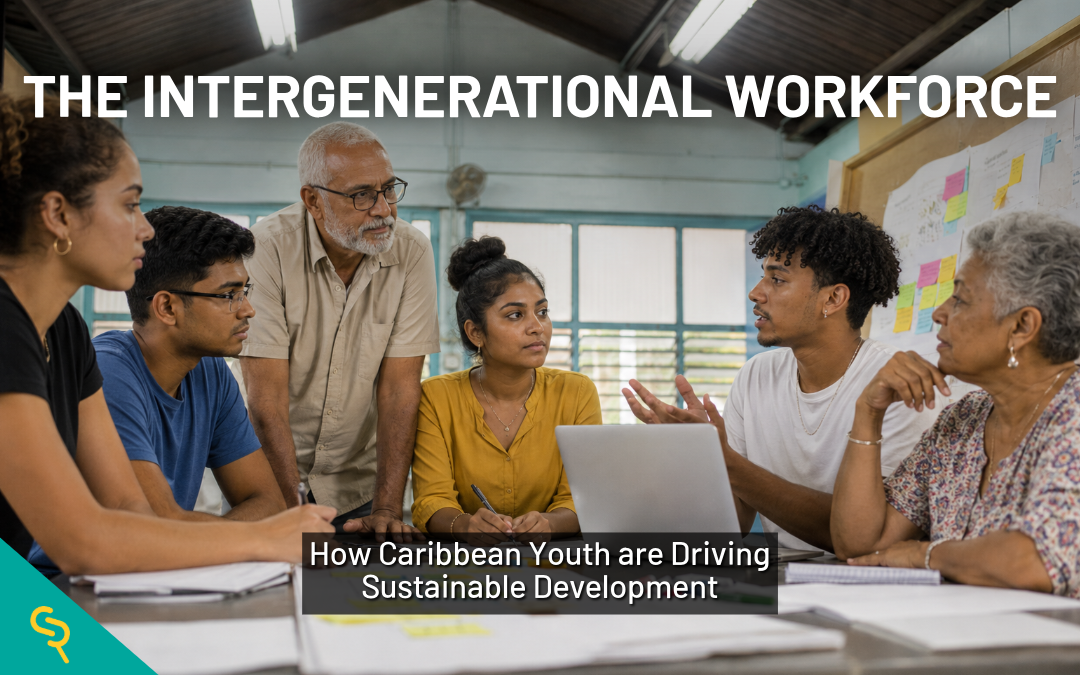
The modern Caribbean workforce increasingly consists of multiple generations working side by side, each bringing different experiences, perspectives, and skillsets. Older generations contribute institutional knowledge, mentorship, and lived experience, while younger professionals often lead digital transformation, sustainability advocacy, and innovation initiatives.
This inter-generational workplace dynamic is becoming increasingly important as organisations seek to remain competitive amid rapid technological change, climate disruption, and economic uncertainty (World Economic Forum, 2023).
Companies that successfully integrate youth perspectives into leadership, sustainability, and innovation strategies are often better positioned to adapt to evolving global expectations around ESG, digital transformation, and social responsibility.
Which Caribbean Companies Are Investing in Youth Leadership?
Corporate Caribbean increasingly recognises that investments in youth development deliver measurable social and economic returns. Across the region, major organisations are implementing programmes that support education, leadership development, entrepreneurship, sports, and environmental sustainability.
Examples of employee-led and youth-focused CSR programmes include:
- Atlantic LNG — Point Fortin’s Finest Leadership Development Programme
- The National Gas Company of Trinidad and Tobago Limited (NGC) — Sporting and skills training partnerships
- Heritage Petroleum Company Limited — Heritage Information Technology Training (HITT) Programme
- PowerGen Trinidad and Tobago Limited — Sporting excellence sponsorship initiatives
- bp Trinidad and Tobago (bpTT) — MARIN coral and seagrass restoration project
- Shell Trinidad and Tobago — Re-Energize T&T youth advocacy programme
- bmobile Trinidad and Tobago — JumpSTART entrepreneurship initiative
- ANSA McAL Group of Companies — Youth Champions leadership development programme
These initiatives highlight how corporate investment in youth can strengthen workforce readiness, entrepreneurship, environmental stewardship, and social inclusion across the Caribbean.
Research increasingly shows that youth-focused CSR programmes contribute positively to long-term corporate sustainability ROI by improving community trust, strengthening talent pipelines, and supporting economic resilience (Deloitte, 2023).
From Gang Culture to Youth Advocacy: The Story of Joshua Hercules
The transformative potential of youth inclusion is also reflected in the work of Joshua Hercules, who has become a strong advocate for youth entrepreneurship and community action after overcoming involvement in gang culture.
Today, Joshua promotes self-awareness, mental health, and entrepreneurship as essential tools for reducing youth violence and creating safer communities (Gouveia, 2024). His journey demonstrates how community support and youth empowerment programmes can help vulnerable individuals transition into leadership and advocacy roles.
Mental health support, self-care, and social inclusion are increasingly recognised as essential components of sustainable youth development strategies globally (World Health Organization, 2022).
Addressing Economic Challenges Across CARICOM
Youth participation is also becoming increasingly important in addressing broader regional development challenges across the Caribbean Community (CARICOM).
In Guyana, agriculture is emerging as a critical pillar of sustainable development alongside the country’s growing oil and gas sector. Expanding agricultural production is viewed as essential to strengthening regional food security and reducing dependence on imported food across CARICOM nations (CARICOM, 2023).
Youth involvement will play a major role in scaling agricultural innovation, improving food systems, and ensuring long-term workforce sustainability within the sector.
As climate change, supply chain disruptions, and economic instability continue affecting the Caribbean, investment in youth entrepreneurship, technology, and agriculture is becoming increasingly important for regional resilience.
The Impact of ESG Reporting Standards and the CSRD on Caribbean Business
Another major issue influencing the future of corporate sustainability in the Caribbean is the introduction of the European Union Corporate Sustainability Reporting Directive (CSRD).
The CSRD is a major piece of ESG legislation that aims to standardise sustainability disclosure requirements for large companies operating within or connected to the European market (European Commission, 2023). The legislation requires organisations to provide transparent reporting on environmental, social, and governance impacts, including climate risks, workforce practices, and sustainability performance.
Although the legislation originates in Europe, its influence is expected to extend globally, including to Caribbean companies involved in international supply chains, energy markets, manufacturing, and export industries.
The growing emphasis on ESG reporting standards signals a major shift in how corporations measure accountability and sustainability performance. Caribbean businesses that proactively adopt sustainability disclosure practices may gain stronger investor confidence, improved stakeholder trust, and enhanced international competitiveness.
Building a Sustainable Caribbean Through Intergenerational Collaboration
The future of sustainable development in the Caribbean will depend heavily on collaboration between generations. Youth bring innovation, adaptability, and digital fluency, while older generations contribute experience, mentorship, and institutional knowledge.
Together, this inter-generational workforce has the potential to address some of the Caribbean’s most pressing challenges, including climate resilience, economic inequality, food security, education access, and workforce transformation.
As Caribbean youth continue leading change across technology, activism, education, entrepreneurship, and sustainability, their role in shaping a secure, inclusive, and resilient future will only become more significant.
References
CARICOM. (2023). Regional food security and agricultural transformation strategy. Caribbean Community Secretariat. https://caricom.org
Commonwealth Secretariat. (2023). Commonwealth Year of Youth 2023. Commonwealth Secretariat. https://thecommonwealth.org
Deloitte. (2023). Global trends in corporate social responsibility and ESG investment. Deloitte Insights. https://www2.deloitte.com
European Commission. (2023). Corporate Sustainability Reporting Directive (CSRD). European Commission. https://finance.ec.europa.eu
Gouveia, S. (2024). Corporate Sustainability Review 2023–2024, 3–4. The intergenerational workforce
United Nations. (1965). Declaration on the Promotion among Youth of the Ideals of Peace, Mutual Respect and Understanding between Peoples. United Nations. https://www.un.org
United Nations. (2023). Youth and the Sustainable Development Goals. United Nations Sustainable Development Goals. https://sdgs.un.org
World Economic Forum. (2023). The future of jobs report 2023. World Economic Forum. https://www.weforum.org/reports/the-future-of-jobs-report-2023/
World Health Organization. (2022). Mental health and young people. World Health Organization. https://www.who.int